
MTHS partners with NJ colleges to offer dual credit and early college options
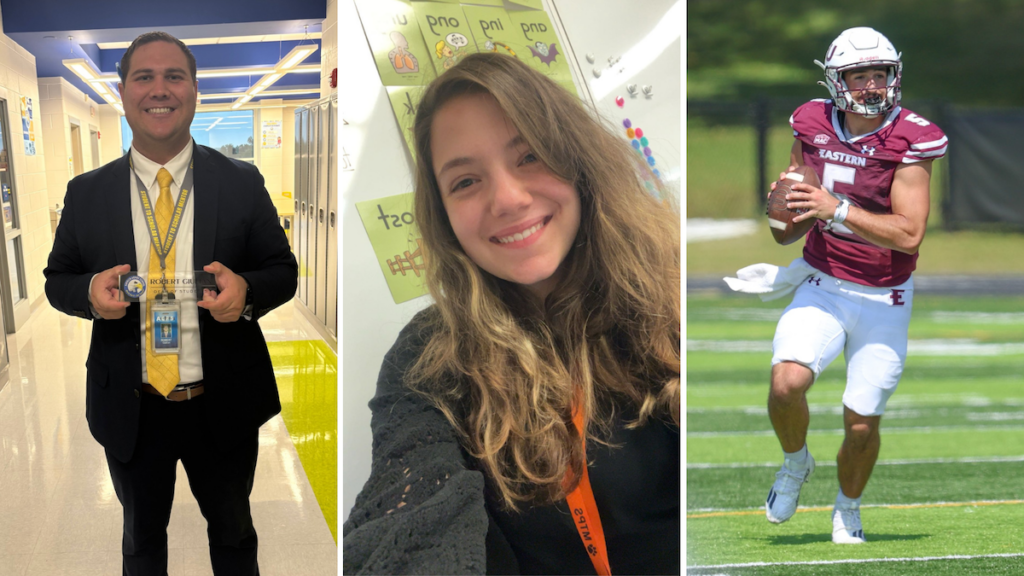
Where they are now: Middle Township High School alumni Rob Giulian (from left), a school administrator in Virginia; Angelina Maffei, an in-class resource teacher at Middle Township Elementary #1; and Brett Nabb, a quarterback and graduate student at Eastern University, all benefited from college pathway programs.
Cape May Court House, N.J. – Middle Township High School students are graduating with confidence, college credits and real-world experience through enrollment in the school’s college pathway programs.
MTHS offers three programs to help students earn college credits. Students can take dual credit courses that are available at a special reduced fee through Atlantic Cape Community College or Stockton University. An ACCC early college program offers motivated students the opportunity to earn an associate’s degree while still in high school. And students also are earning college credits by recording qualifying scores on Advanced Placement (AP) exams.
The advantages for students include reduced time to earn a college degree, increased access to competitive universities, and more flexibility in academic and career decisions.
But, of course, the money-saving benefits are key. Cost is the determining factor in many families’ decisions about college. For some, a four-year college is financially out of reach, or only possible if a student takes on significant debt.
The cost of enrolling in dual credit courses — $195 each at ACCC and $400 each at Stockton – is a fraction of the regular cost per course at Stockton or another four-year school. The credits are transferable to many colleges and universities. And earning an associate’s degree through the early college program can slash the cost of a bachelor’s degree by almost half. MTHS students pay a $5,400 fee for the early college program.
“Our goal has always been to remove barriers and expand opportunities for students,” said Dr. Sharon Rementer, MTHS principal. “The college pathway programs ensure that students leave our building prepared, confident, and already ahead as they transition to college or career.”
The school is seeing an impressive rate of participation.
- More than a third of MTHS students are taking dual credit courses
- Around 30% of juniors and seniors are enrolled in at least one AP course
- 17 out of 388 juniors and seniors are in the early college program
“From a guidance perspective, dual credit opens doors,” said Joelle Tenaglia, MTHS Director of Guidance. “Students are making more informed postsecondary decisions because they’ve already experienced college-level expectations while still having the support of their high school counselors and teachers.”
All the MTHS teachers who instruct dual credit courses hold graduate degrees. Some of the school’s most rigorous courses are available for dual credit. Around half of the staff members teaching AP courses have a graduate degree.
“Early college is about access and equity,” said Dr. Toni Lehman, Middle Township Public Schools Assistant Superintendent of Curriculum and Instruction. “By intentionally aligning our curriculum with postsecondary expectations, we are giving students time, financial savings and confidence. All of which are three resources that change life trajectories.”
Stephanie DeRose, MTPS superintendent, said the emphasis on college pathway programs aligns with the district’s practice of providing opportunities with long-lasting benefits.
“Our goal is to shape not only successful students, but successful people,” DeRose said. “Students who take advantage of the experiences and opportunities at Middle Township High School gain a competitive advantage and life skills that carry far beyond graduation. This is a message we consistently hear from our alumni.”
Rob Giulian, school administrator
Rob Giulian always sensed that his parents enjoyed their jobs in the education field. His mom is a high school teacher and his dad is a college professor. By the time Giulian began ninth grade at MTHS, he knew he wanted to follow in his parents’ footsteps.
Giulian, a native of Stone Harbor, decided to sign up for college pathway programs to get a head start on his education. He enrolled in AP classes and dual credit courses. Giulian graduated from MTHS in 2018 with 35 college credits, all which transferred to Shippensburg University, where he continued his education.
“The advanced classes and college courses I took in high school gave me a jump start toward earning my degree,” said Giulian. “I entered college as a freshman but was technically a sophomore due to the transferred credits and was able to graduate with a bachelor of science degree in history education in three years.”
The money he saved on undergraduate tuition gave Giulian the flexibility to continue his studies and earn a Master of Education in educational leadership from George Mason University. Giulian is now the dean of students at the Patrick Henry School in Alexandria, Va.
“I would encourage any student that wants to attend college, a trade school or enter the military to participate in the college pathway program at MTHS,” said Giulian. “Besides financial and time benefits, the program teaches so many life skills like time management and leadership qualities. The rigorous courses also let you explore many different topics, so you learn more about yourself and your interests.”
Brett Nabb, graduate student
A star athlete at MTHS, Brett Nabb was often found on the field playing football and lacrosse for the Panthers. But he put just as much dedication and discipline into training for college. Nabb, of Avalon, participated in the early college program at MTHS and graduated in 2022 with both a high school diploma and an ACCC associate’s degree.
The early college program requires MTHS students to take a combination of dual credit courses and ACCC courses. The college courses can be taken online or at one of ACCC’s three campuses.
With an associate’s degree already in hand, Nabb was able to complete a bachelor’s degree in business administration in two years at Eastern University. This spring, Nabb will earn a Master of Business Administration in organizational management from the university.
“Being in high school and taking college courses opened up so many new career opportunities for me,” said Nabb. “And having the associate’s degree credits transfer to Eastern University cut my college costs in half. It allowed me to get a bachelor’s degree early and start working on my master’s degree.”
Nabb also has continued his athletic success. A standout quarterback at Eastern, he led the Eagles to their first conference title in 2025, throwing for 1,237 yards and rushing for 1,107 yards. Because of his accelerated academic timeline, Nabb will still be eligible to play in the fall when he returns to Eastern to study for a second master’s degree in data science.
“I’d tell students to take college courses in high school,” said Nabb. “There are so many benefits, including making the transition from high school to college easier. The courses give students exposure to the work that is expected in college and helps them figure out what they want to do professionally.”
Angelina Maffei, in-class resource teacher
Angelina Maffei’s love of reading and education was inspired by her grandmother. When Maffei was a freshman at MTHS, her grandmother was the one who encouraged her to take more challenging classes – so Maffei enrolled in the school’s early college program.
Maffei, of Cape May Court House, studied hard in her AP classes and dual credit college courses. By the time she graduated in 2022, Maffei earned a high school diploma and an associate’s degree from ACCC. She was thrilled to participate in both schools’ graduation ceremonies.
After graduation, Maffei attended Stockton University and earned a bachelor’s degree in liberal studies with a concentration in elementary education and a minor in childhood studies. She completed her degree in two years, thanks to the college credits she earned while at MTHS. The MTHS Early College program also saved Maffei a substantial amount of money, allowing her to pay the remainder of her college expenses with academic scholarships and her salary from her ShopRite job.
“I am so happy to have graduated in two years with no student loans,” said Maffei. “And it’s amazing to say I was hired as a teacher at the age of 21. I knew I wanted to be a teacher since I was in kindergarten. The MTHS Early College program helped me achieve my longtime goal.”
Now she’s back where her educational journey began. Maffei works for Middle Township Public Schools as a first grade in-class resource teacher.
“It’s a nice coming home-type thing to return to Middle Township schools,” she said. “It’s so great to see and teach the next generation of Panthers.”
Amy Giulian, parent
Amy Giulian is a special education history teacher at MTHS, and her husband, Karl, is an associate professor of business at Atlantic Cape Community College and an adjunct professor at Stockton University.
Education has always been a priority in the Giulian family, and the Stone Harbor couple began a college fund soon after the birth of their first child.
As their family grew to four children and Amy learned about the MTHS college pathway programs, the Giulians jumped on the opportunity to stretch the college fund.
Their children – Rob, Cate, Karl and Dave – all attended MTHS and graduated with transferrable college credits after taking AP classes and dual credit courses.
These credits helped Rob, Cate, and Karl graduate early from college with bachelor’s degrees. Dave wanted to participate in college football and wrestling for four years, but was able to take fewer classes each semester because of the college credits he earned at MTHS.
“I would highly recommend the MTHS college pathway programs to other families,” said Amy. “We saved significantly on our children’s education. Among all our kids, we saved about three-and-a-half years of college at around $60,000 or more a year.”
She added, “The AP classes and the ACCC classes teach the kids the difference between high school and college. In college, they are no longer being spoon-fed. It is their responsibility to complete the work. It makes the transition to college easier.”